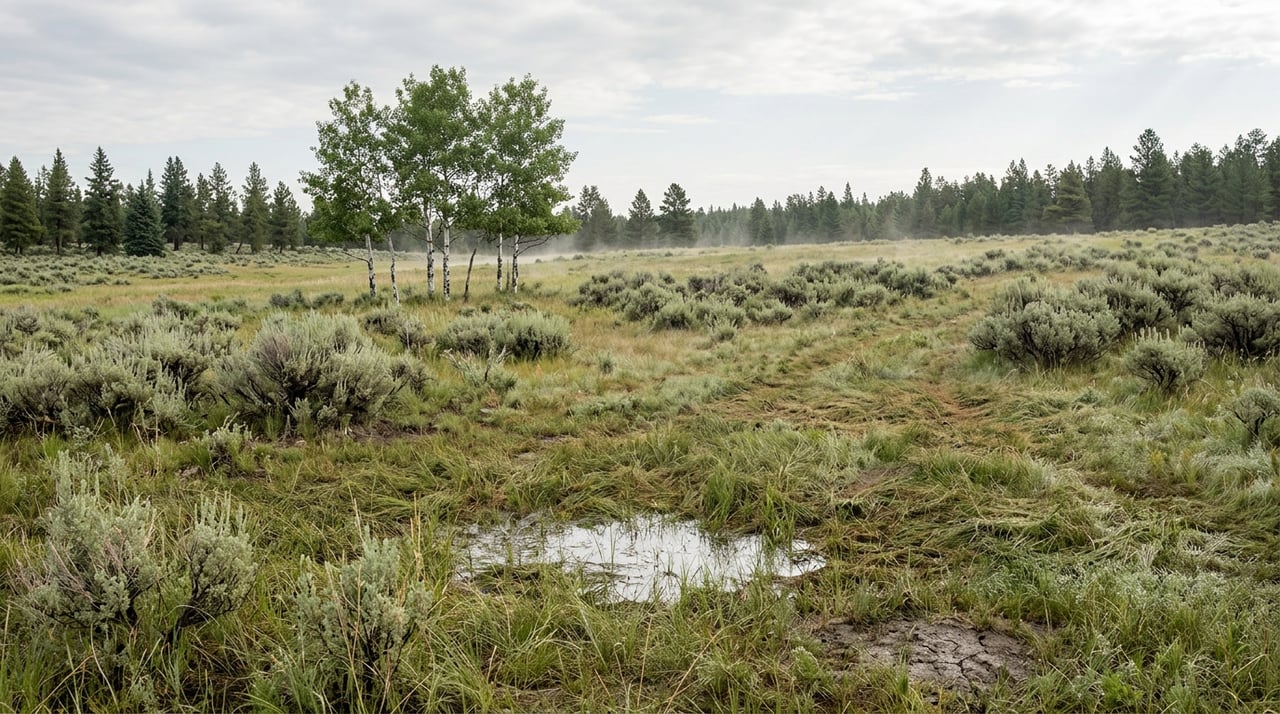
Nick Beard has grazed cattle on a stretch of sagebrush and grassland roughly three miles north of Tetonia since 1992. His family paid the state of Idaho about $950 a year for the privilege, a lease that was supposed to run until 2032. Then in the summer of 2025, the Idaho State Board of Land Commissioners voted to sell the 160 acres anyway, breaking the lease early because the fine print allowed it and because the land wasn't earning what the state's endowment model said it should.
In May 2026, the parcel known as the Driggs 160 went to auction at a hotel outside Boise. One bidder showed up. The land sold for exactly $5 million, the minimum reserve, which works out to $31,250 an acre. The buyer was TR Lot Holdco LLC, one of the entities billionaire Thomas Tull uses to hold his roughly 8,000-acre Teton Ridge Ranch, which borders the parcel on two sides.
If you've been watching Tetonia land prices and treating that number as a new data point, it's worth understanding what actually produced it before you use it for anything.
The Appraisal Made a Choice Before the Bidding Started
The state's own valuation didn't start from a blank slate. Three sides of the Driggs 160 parcel are zoned to allow subdivision into 20-acre parcels, and two of those three sides happen to be owned by Tull. The fourth side currently permits 10-acre splits, a denser and more valuable configuration for a developer. The Idaho Department of Lands based its appraisal on the 20-acre scenario, the more conservative of the two, even though the 10-acre zoning on that fourth boundary would have supported a higher number.
That single decision matters more than any comp sheet.
| Zoning basis used | What it allows | Effect on the appraisal |
|---|---|---|
| 20-acre minimum parcels | Larger lots, closer to the ranch model already surrounding the property | Lower theoretical yield per acre, lower reserve price |
| 10-acre minimum parcels | More potential building sites carved from the same 160 acres | Higher theoretical yield per acre, higher reserve price |
Jacob Bottles, the broker who ran the auction for Bottles Real Estate Auctions, said comparable parcels in the area have recently traded between $36,000 and $60,000 an acre, depending on infrastructure already in place. The $31,250 reserve came in below that entire range. Bottles told reporters covering the sale that he expected the final price to land higher than the floor.
It didn't. It landed exactly on it, and only one party bid.
The Scarcity Story and the Empty Room Don't Match
Bottles opened the auction by telling the room that properties like this one are getting harder and harder to come by. He wasn't wrong. Teton Valley has been absorbing new subdivisions for years, and conservation biologist Michael Whitfield, who founded the Teton Regional Land Trust and previously sat on the county commission, described the pace of development as something you can't avoid seeing on any drive through the valley.
So why did a scarce, view-rich parcel bordered by public land on one side draw a single bid at a price below the going comp range?
The answer isn't that the land was overpriced or that demand had gone soft. It's that the reserve price was set at a level that only ever needed to attract one particular kind of buyer, someone for whom this specific 160 acres was worth more than it would be to almost anyone else. Tull already owns two of the four boundary lines. Folding this parcel into Teton Ridge Ranch means no new access road, no new fence line negotiation, no new well or utility hookup that a standalone buyer would have to build from nothing. For an adjacent owner, absorbing a neighboring parcel is close to pure addition. For anyone else, it's a fresh start on infrastructure, permitting, and access, all of which get baked into what an unrelated buyer is willing to pay per acre.
That gap between what a parcel is worth to its neighbor and what it's worth to a stranger has a name in appraisal circles, assemblage value, and it rarely shows up as a line item on a listing sheet. It showed up here because the state was required to hold a public auction and disclose the terms. Most of the time it stays invisible, folded into a private negotiation nobody reports on.
What a Single Print Should and Shouldn't Tell You
If you're comparing land near Tetonia against other pockets of Teton Valley, the $31,250-an-acre figure from this auction is going to circulate as a talking point for a while. Treat it as a data point about one buyer's specific incentives, not as a market floor or ceiling.
The more useful number Bottles put on the record is the $36,000 to $60,000-plus per acre range for comparable parcels with infrastructure already in place. That range still isn't a single price. It moves with whether a well exists, whether power and access are already built, and critically, with what the zoning underneath a specific parcel actually permits. A 20-acre-minimum lot and a 10-acre-minimum lot sitting side by side can carry meaningfully different values per acre even with identical soil, views, and road frontage, because one supports more building envelopes than the other.
That's the question worth asking before anyone quotes you a per-acre number for land near Tetonia: is this price attached to the zoning that's actually on the parcel, or is it borrowed from a different parcel down the road with different subdivision rights.
Averages compound the confusion. Land.com's current listings across Teton County show an average lot size of 134 acres and an average asking price of just over $3 million, but that average is pulled upward by large ranch and estate listings, not by the smaller building lots most buyers are actually shopping for in and around Tetonia. Movoto's snapshot of Tetonia single-family listings in August 2026 put the median asking price at $1.48 million, with price per square foot down 8 percent from a year earlier even as time on market held roughly steady at a median 95 days, a very different picture than a $3 million average acreage listing would suggest. Both numbers are true. Neither one is the whole market.
The Longer Game Behind the Bid
Beard, for his part, said he was relieved Tull won the auction rather than a developer looking to carve the parcel into what he called a mini subdivision. Tull's spokesperson confirmed after the sale that the family would be offered a new grazing lease on the same terms, and that the land would stay undeveloped, consistent with how Tull manages the rest of his holdings in the valley.
That intent lines up with a pattern that's been building for more than a year. Tull's Teton Ridge Ranch Foundation has put more than $3.5 million into Teton Valley institutions recently, including a multi-year commitment to the Teton County Sheriff's Foundation, a donation to Teton Valley Health, funding for Teton County Idaho Search and Rescue, upgrades at the county fairgrounds, and a parcel of land donated outright to Teton Valley Housing for future workforce housing. None of that giving was contractually tied to the land auction, and Tull's team has been direct that any suggested connection is false. But it does tell you something about the kind of buyer who was willing to pay $31,250 an acre for ground most people would have valued differently: someone already deeply invested in the valley staying recognizable, not someone testing the market for a return.
If you're evaluating land near Tetonia with an eye toward building, holding, or eventually selling, the lesson from this auction isn't a number to memorize. It's a habit to adopt. Before you anchor to any recent sale, ask what zoning sits under that specific parcel, what infrastructure is already there, and whether the buyer who set that price had a reason to pay more than a stranger would.
A Few Questions Worth Asking
Does a low-bidder auction mean Tetonia land is undervalued right now? Not necessarily. This sale drew one bidder because the buyer had a structural advantage, existing adjacent ownership, that most buyers won't have. A thin field doesn't automatically mean a soft market.
How much does zoning actually change what a parcel is worth per acre? Enough that the state itself chose to appraise this parcel under the more conservative of two zoning scenarios available on its own boundaries. A 10-acre-minimum lot and a 20-acre-minimum lot next to each other can carry very different per-acre values even with identical land quality.
What should I ask before treating any recent sale as a comp? Start with what the zoning under that exact parcel permits, whether infrastructure like power, water, and access already exists, and whether the buyer had a reason, like adjacency or assemblage, to pay above what an unrelated buyer would.
Land near Tetonia rewards buyers who read past the headline number. If you're weighing a parcel, a build site, or a resale in this part of Teton Valley and want a second set of eyes on what the zoning and comps actually support, Coldwell Banker Mountain Properties - Jackson Hole is a good place to start that conversation. Let's Connect.